
From the field · Motorcycle parts
From a motocross track to a 924-parcel day.

Antoine SeptierCEO, 3AS Racing
Born on a motocross track in Normandy, 3AS Racing sells more than 300,000 technical motorcycle parts online, using a just-in-time model. With Boostmyshop, the same team broke its picking record.
3AS Racing sells technical motorcycle parts online to customers who ride, compete, and fix their own bikes. The business began on a motocross track in Normandy, selling a few parts to riders, before opening its first online store around 2005 or 2006. Now based near Bordeaux, it lists more than 300,000 SKUs online, each tied to compatible vehicles, with about 20,000 held in stock. Boostmyshop runs receiving, wave picking, shipping, and purchasing.
- SKUs online
- 300,000 about 20,000 of them in stock
- Logistics floor area
- 2,500 m² about 10,000 locations across five zones
- Orders a day
- ≈ 400 10,000 to 12,000 a month
- Parcels in one day
- 924 record, same team of 7 FTEs
Choosing Boostmyshop · before signing
It worked right away.
When 3AS Racing had to change systems, it wanted two things: warehouse software close to what the team already knew, so it wouldn’t have to change everything at once, and purchasing in the same tool.
“The tool really worked right away, perfectly, and from there we try to tailor it a little to our needs, but we haven’t customized it all the way.”
3AS Racing has run on Boostmyshop since September 2024. Its catalog is substantial: more than 300,000 SKUs online, each linked to compatible vehicles.
Over 25 million fitment links
Just-in-time
How do you sell 300,000 SKUs without holding them all?

“What’s specific to our business is that we have a large catalog, but one SKU sometimes means several suppliers, with different lead times and different prices.”
Of the more than 300,000 SKUs online, about 20,000 are in stock at the warehouse. Roughly two-thirds of customer orders therefore trigger a supplier order, delivered the next day or the day after, and 65 to 70% of received products ship out again the same day.
A single SKU may have six or seven suppliers, each with different lead times and prices. In Boostmyshop, rules pick the supplier based on three criteria: the supplier’s stock first, then lead time, even if the fastest one costs a little more, and finally price. The calculation reruns automatically every day.
The product journey
A tour of the warehouse.
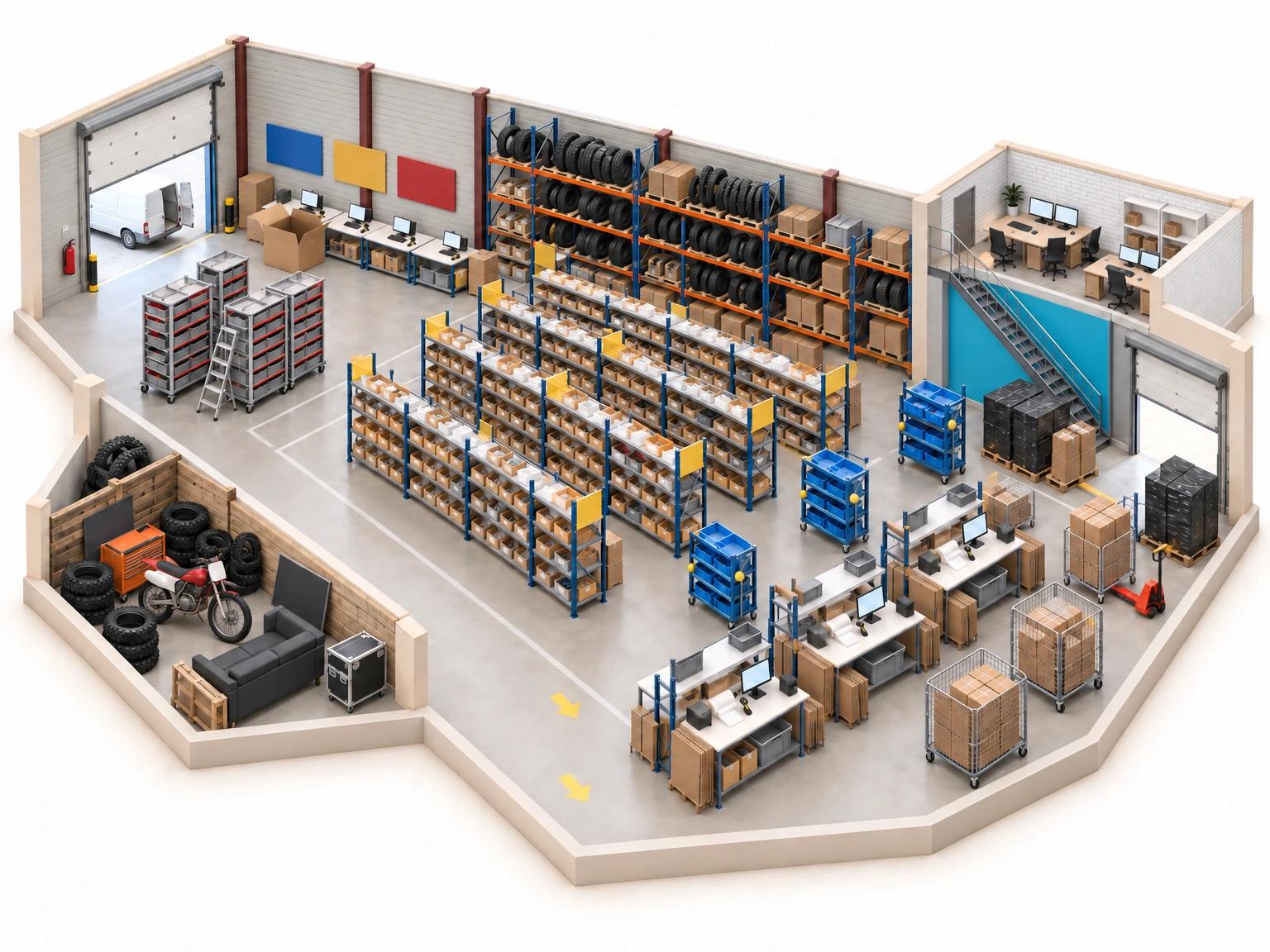
Deliveries are checked at four stations. Products for single-item orders go straight to packing. The rest wait in the buffer zone, whose contents are put away across the five zones each evening. Picking waves are built by zone, parcels ship from the packing stations, and purchasing orders what is missing each day. In this just-in-time model, most SKUs are not held in stock: a customer order often triggers a supplier order.
01 / Receiving
The beep that flags single-item orders
Deliveries come in at four receiving stations beside the delivery door. The stations handle 1,000 to 2,500 products a day; most receipts are logged without opening the purchase order first. When a product is needed for a single-item order, Boostmyshop flags it as soon as it is scanned.
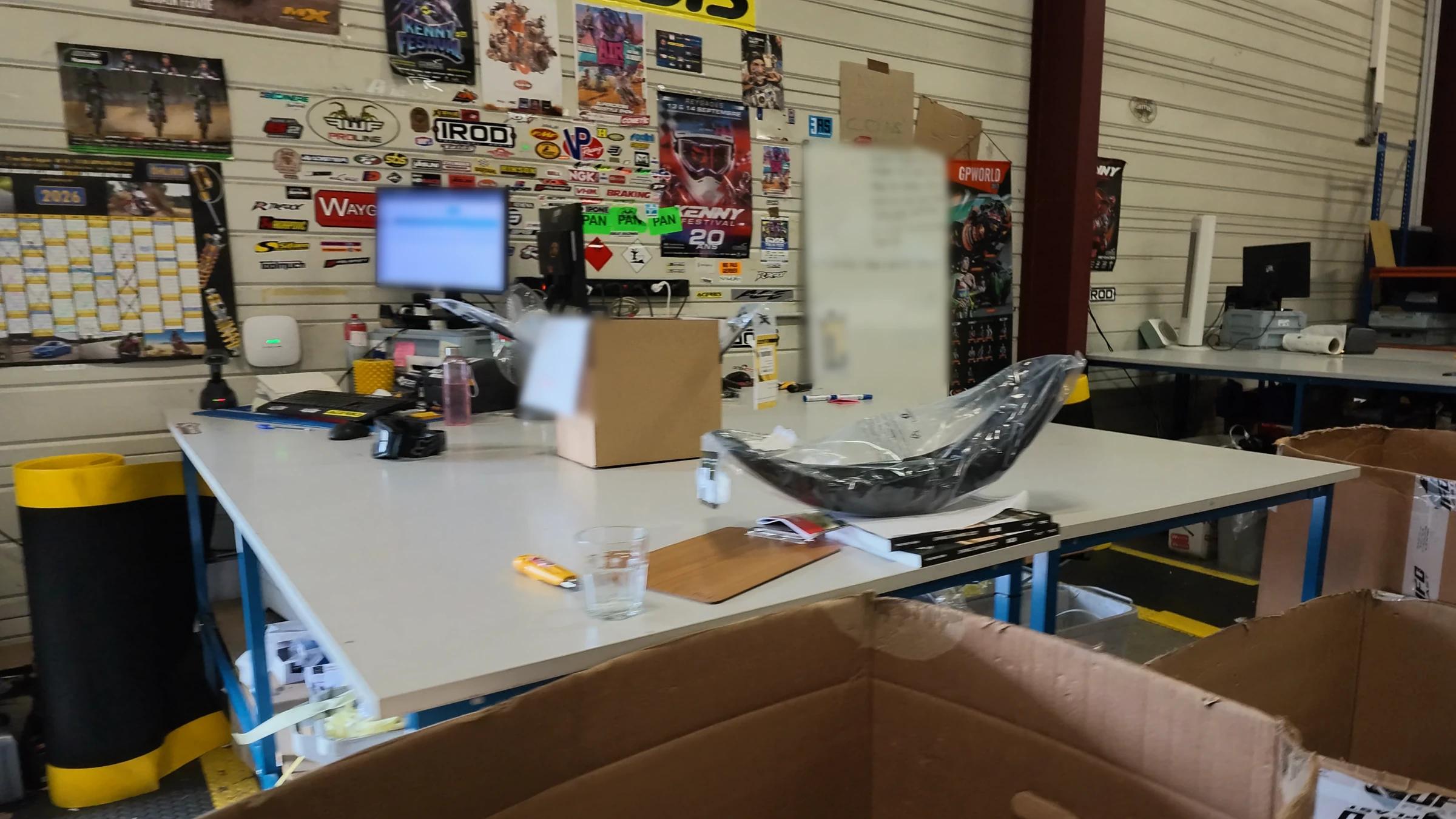
“Boostmyshop really helps us ship these orders extremely quickly, because right at receiving, it flags that this is a special, single-item order, and we set the product aside as soon as we hear that sound.”
Just under half of all orders contain a single item. When the product for one of these orders is scanned, a distinctive sound flags it. The product is set aside in a large carton and goes straight to packing, bypassing picking.
02 / Buffer zone
A buffer zone that mirrors the warehouse
Products received during the day go into bins laid out like the warehouse, each labeled with the locations it mirrors. Picking takes products from these bins, and whatever has not shipped is put away in the aisles that evening.
“These bins are basically a map of our warehouse. It’s a buffer zone where products stay when they haven’t shipped today, because the customer orders aren’t complete. So at the end of the day, this whole buffer zone gets put away in the aisles behind you.”
For putaway, Boostmyshop prints one label per product with its description, SKU, and location.
- 1
The bins
Each bin bears the warehouse locations it mirrors.
- 2
Today’s picking
Waves collect the products received that day.
- 3
Evening putaway
Anything left is put away in the aisles at the end of the day.
 123
03 / Zones and waves
Five zones, waves built by zone
The warehouse is split into five zones. Zone 1, closest to shipping, covers aisles A, B, and C; zone 5 holds bulky products. Boostmyshop builds picking waves by zone, keeping each picking run within the zones it needs.

“So with Boostmyshop, here in our warehouse, which is fairly large, so that we don’t have to cover the entire warehouse on every picking run, the warehouse was divided into zones.”
The wave assistant’s rules combine zones 1 and 2, zones 1 through 3, zones 1 through 4, or zone 5 on its own, and cap the number of orders in each wave. Each wave prints on a sheet showing the location, quantity, and bin number, then goes out on a 25-bin cart with one bin per order.
Zones 1 to 4 for a newcomer
04 / Packing and shipping
Scan the product, print the label
Wave carts arrive at eight packing stations, with two more kept in reserve for peaks, while products from single-item orders arrive directly from receiving. The product is scanned, the order appears, and a second scan prints the carrier label.
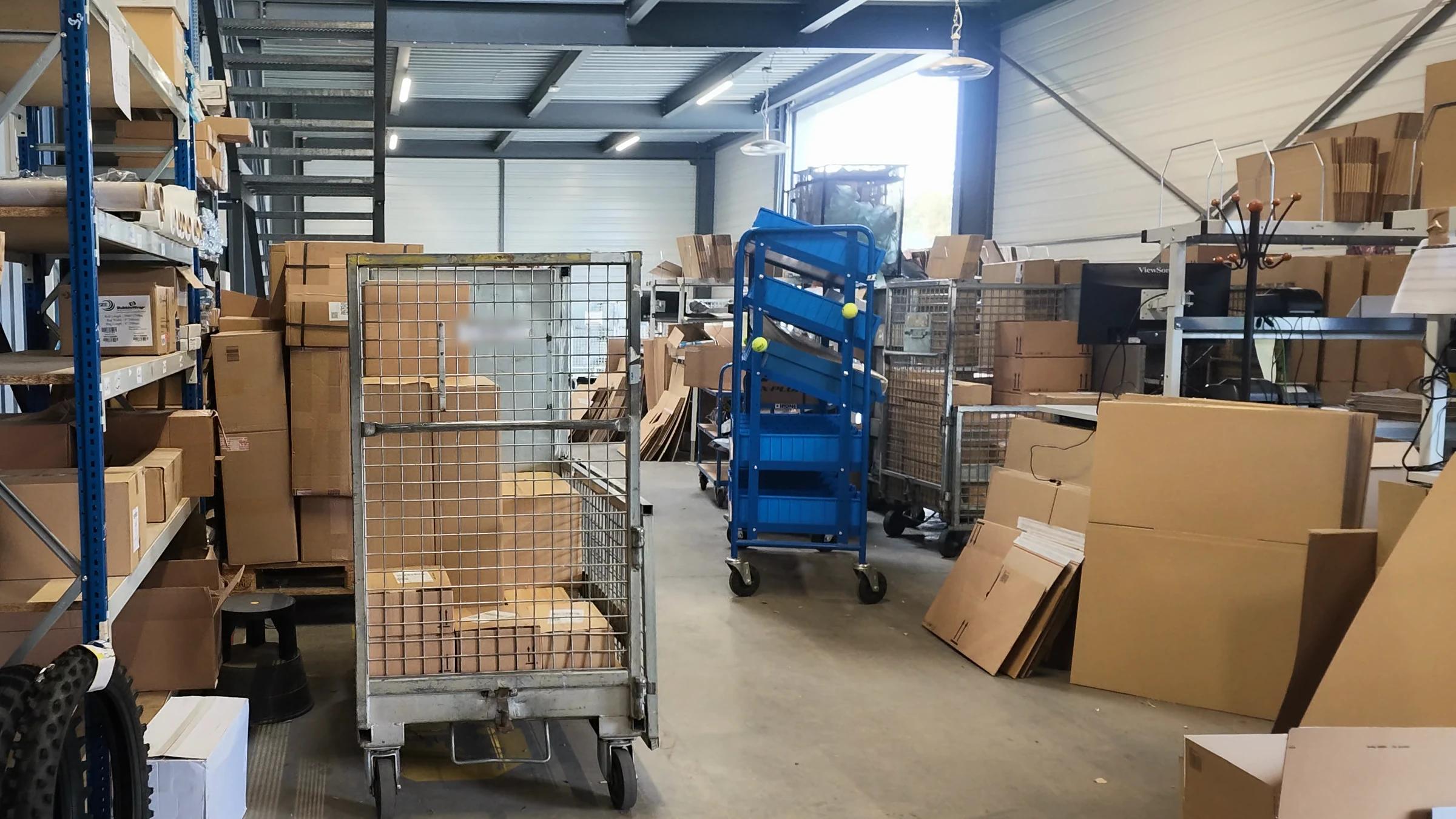
“They’re set aside at receiving, they’re brought to packing, and there, the packer scans the product and it pulls up the order.”
Standard parcels ship via Colissimo or Chronopost, and bulky shipments go by Geodis. The labels print automatically from Boostmyshop.
05 / Purchasing
Every day, a list of products to order
Upstairs, Boostmyshop’s replenishment view gathers every product that needs ordering that day: customer orders that stock cannot cover and fast-selling products running low. 3AS Racing works with more than 100 suppliers and orders from 60 each day; one person is enough to handle day-to-day purchasing.

“In this view, the replenishment view, this is where we see all the products that need to be ordered each day.”
For each product, the buyer selects a quantity: the minimum that covers the customer order, or more to replenish stock. The order then goes out by email from Boostmyshop, or as a file to upload to the supplier’s B2B site.
Stock first, then lead time
With Boostmyshop · day to day
No outages since September 2024.
Parts bought directly from the factory, year-end rebates negotiated with some suppliers, deliveries that arrive in several shipments: at 3AS Racing, these special cases are handled in the same tool as the warehouse.
“In terms of reliability, it’s relatively stable. Since September 2024, we haven’t had any server outages, or any trouble of that kind.”
3AS Racing’s special cases, handled in Boostmyshop
- Factory purchases
Some parts are bought directly from the factory and take longer to arrive. For those products, a configured exception replaces the shortest-lead-time rule.
- Year-end rebates
Year-end rebates negotiated with several suppliers feed into the comparison. When lead times are equal, the order goes to the supplier with the best terms.
- Incomplete deliveries
Delivery tracking surfaces supplier orders that did not arrive in full, so the team can follow up with the supplier.
“I think it used to take eight of us to do 300 parcels. Today, seven well-trained people can handle 500 or 600.”
Before / after
Picking records
Before and after Olivier’s visit in March, it was the same logistics team: seven FTEs.
762 parcels, with reinforcements from across the company
924 parcels, the same team
The same seven-FTE team broke its record three times between April and May.
A weekly export and a manual comparison
Recalculated automatically every day
Delays caused by the one-week lag disappeared.
300,000 products to synchronize at launch
A few days of adjustments
Once the data was loaded, the warehouse was running within days.
What this example shows
With Boostmyshop, purchasing picks the right supplier every day; since Olivier’s visit, the same team ships more.

Your turn
What if every SKU found the right supplier, every day?
Pick one SKU you do not hold in stock. How many suppliers can deliver it, how quickly, and on what terms? Who decides, and how often?
Show that case to the Boostmyshop team. It is a better starting point than a general demo.
Thank you to Antoine Septier, Cyril Jemy, Pierre Cazenave, and the 3AS Racing team for welcoming us into their warehouse and purchasing office.