
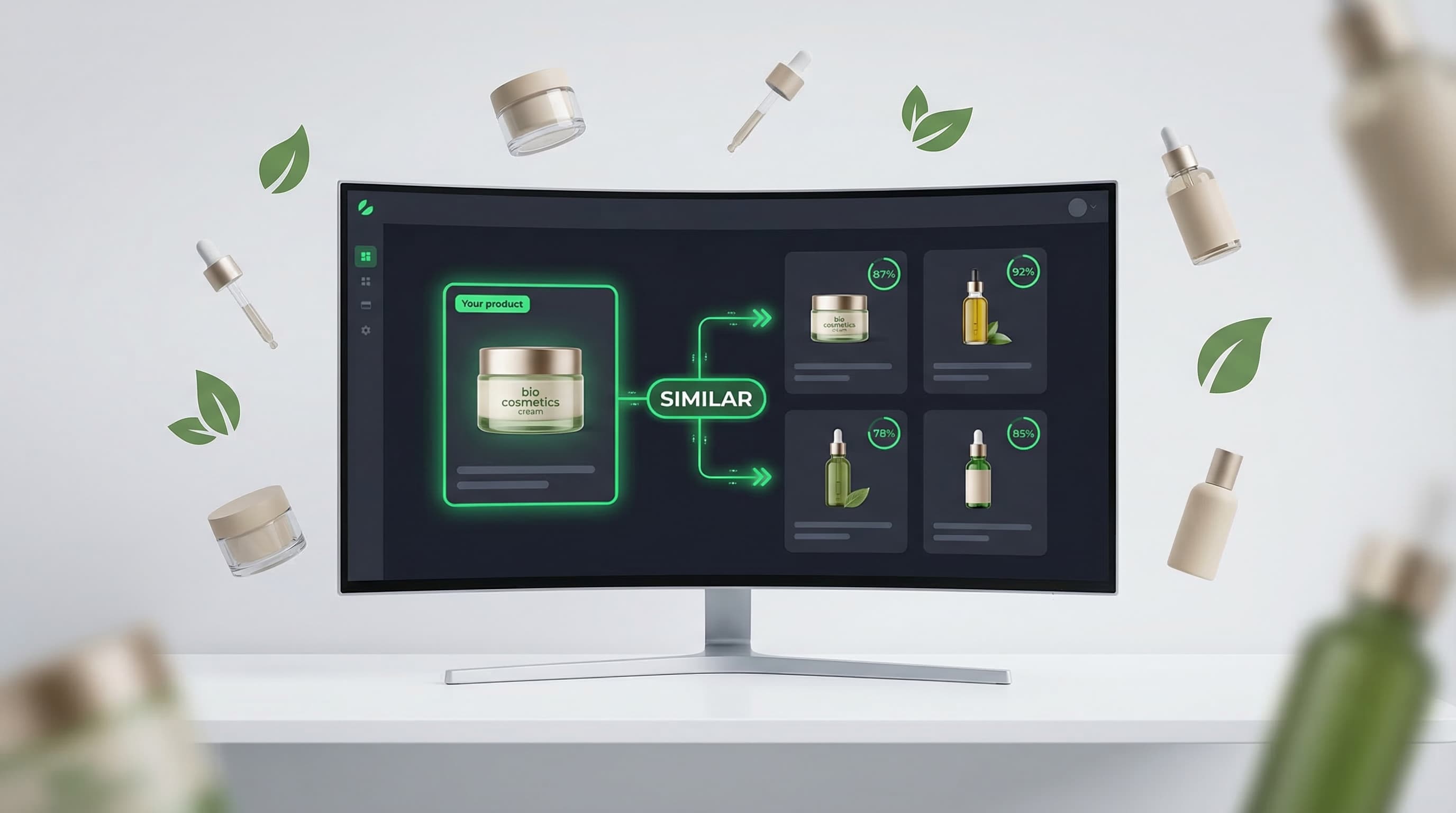
How Similar Matching Gave an Organic Cosmetics Brand Competitive Visibility for the First Time
Competitive visibility (private label)
Zero — completely blind on own-brand products → Equivalent competitors identified for every private-label SKU
Market research time
Hours of manual Google searches weekly → Automated monitoring — price changes visible within the day
Pricing confidence (own products)
Guesswork — fixed coefficients, no market data → Market-informed pricing based on real equivalent prices
A French organic cosmetics company operating on Magento. They are both a distributor of known brands (Avène, Bioderma, Nivea) and a manufacturer of their own private-label organic products — nourishing creams, essential oils, natural treatments. Their catalog contains around 5,000 SKUs split roughly between distributed brands and own products. They sell primarily through their own website, with products indexed on Google Shopping via Google Merchant Center.
The Challenge
The company had two distinct pricing challenges. On distributed branded products (Avène, Bioderma), standard competitive intelligence worked fine — MyMarket identified other sellers carrying the same products and myPricing adjusted prices accordingly. But on their own private-label products, they hit a wall. Since they're the only seller of their brand, no competitor data existed. The product pages on Google Shopping showed their listing alone. Yet the actual market was full of alternatives — L'Oréal, other organic brands, and smaller local manufacturers all sold equivalent products at varying prices. Customers comparing a '50ml organic nourishing cream' would see all of them. The seller was manually searching Google Shopping for generic terms like 'crème nourrissante bio' and scanning results to understand where they stood. Slow, incomplete, and done every week.
Top challenges:
- Private-label products had zero competitive intelligence — no other seller carries their brand
- Manual Google searches for equivalent products were time-consuming and incomplete
- Fixed-coefficient pricing on own products had no connection to the competitive market
The Solution
We deployed MyMatching in similar product mode for their private-label catalog.
What We Configured
Instead of searching for exact product matches (same EAN, same brand), we configured the matching engine to find equivalent products from other brands. The AI analyzes product type, ingredients, organic certifications, format (cream, oil, serum), size, and price positioning to identify the most relevant competitors. The seller added custom AI instructions specific to their niche: prioritize products with similar organic certifications, exclude products containing certain chemicals their customers avoid, and weight ingredient lists heavily in similarity scoring. The matching engine searches Google Shopping, runs image comparison and semantic text analysis, applies an LLM arbitration pass, then assigns a confidence score to each equivalent match.
The seller is also a manufacturer. Their private-label organic creams and oils had zero competitive data — not because competitors didn't exist, but because no standard matching tool can find them. Similar matching changed how they price their entire own-brand catalog.
Key benefits:
- AI similar matching identifies equivalent competing products from other brands — no manual search required
- Custom AI instructions define what 'similar' means for their specific organic cosmetics niche
- Full catalog coverage: standard matching for distributed brands + similar matching for private label
The Results
Competitive visibility (private label)
Zero — completely blind on own-brand products → Equivalent competitors identified for every private-label SKU
Market research time
Hours of manual Google searches weekly → Automated monitoring — price changes visible within the day
Pricing confidence (own products)
Guesswork — fixed coefficients, no market data → Market-informed pricing based on real equivalent prices
The seller finally had competitive context on their entire private-label catalog. Products that had been priced by gut feeling — a fixed coefficient on production costs — now had market-based positioning. They found products priced below equivalent organic offerings from larger brands — margin left uncaptured. Others sat above the competitive set, which explained lower conversion on those lines. The automated monitoring runs continuously, so when a competitor launches a new equivalent or changes a price, the seller knows within the day. Standard matching on distributed brands plus similar matching on private label gives them full catalog coverage.
Understand this case in video
Not just for cosmetics
Any brand that manufactures or distributes private-label products faces the same blind spot — no competitor data on products only they sell.
- Food brands with own-recipe products that compete on category terms against larger manufacturers
- Fashion brands with private-label lines where 'similar style' defines the competitive set, not brand
- Any manufacturer selling direct-to-consumer who needs to understand how equivalent products are priced in the market
Check out more
How 50% of Our Clients Automate Cross-Dock and Dropship Supplier Fulfillment
50%+ of myFulfillment clientsRead storyBedroom products e-commerceHow We Replaced Scissors with Algorithms for a Multi-Country Bedroom Products Seller
5 Shopify sites + 20 marketplaces, FR + ESRead storyFashion & accessories DTCHow a DTC Fashion Brand Re-Internalized Logistics from Their 3PL in 3 Days
2,000+ orders/monthRead storyHealth supplements & cosmeticsHow a Health & Wellness Retailer Achieved 100% Lot Traceability with FIFO Enforcement
800+ SKUs with expiry datesRead storyHigh-tech / Consumer electronicsHow AutoPilot AI Focuses Repricing on the Products That Actually Matter
~1,000 SKUs, multiple marketplacesRead storyElectrical equipment (B2C + pros)How We Built a Custom Cable Cutting Workflow for an Electrical Retailer
B2C + professional electriciansRead storyHome & garden e-commerceHow a Multi-Channel Retailer Replaced Excel Chaos with One-Screen Order Management
5 sales channelsRead storyElectronics e-commerceHow an Electronics Distributor Eliminated 90% of Label Errors with Centralized Shipping
3,000+ daily shipmentsRead storyMotorcycle parts & accessoriesHow AI Matching Achieved 99% Accuracy on 200,000 Complex Motorcycle Parts
200,000+ SKUs, PrestaShop + Google ShoppingRead storyGardening & pet supplies retailHow a Gardening Retailer Got 34% More Clicks Without Raising Ad Spend
25,000+ SKUs, 50+ year-old family businessRead storyGifts & gadgets retailHow a UK Retailer Turned 5 Stores Into Omnichannel Fulfillment Nodes
5 physical stores + Shopify onlineRead storyHunting & outdoor equipmentHow a Hunting Equipment Specialist Deploys 5 POS Terminals in Minutes at Trade Shows
2 physical locations + online storeRead storyHunting & outdoor equipmentHow a Hunting Equipment Specialist Sells the Full Warehouse Catalog From Any Store Counter
2 physical locations + online storeRead storyCandle & fragrance manufacturingHow BOM-Based Stock Calculation Tripled Sellable Inventory for a Candle Manufacturer
4 e-commerce sitesRead storyHome equipment retailHow We Guaranteed Profitability Across 10+ Marketplaces for a Home Equipment Retailer
10+ marketplaces, thousands of SKUsRead storyHome & garden equipmentHow a Brittany Retailer Turned Warehouse Walk-Ins Into 25% of Revenue
€3M revenue, 10+ marketplacesRead storyParapharmacy / Health & wellnessHow Inverted Pricing Reports Turned Market Data into Supplier Negotiation Leverage
5,000-6,000 SKUs, Shopify + Google ShoppingRead storyMulti-brand retail / e-commerceHow We Built an Omnichannel B2B2C System Connecting Retail Stores to E-Commerce Inventory
E-commerce + retail storesRead storyThird-party logistics (3PL)How We Built Error-Proof Warehouse Workflows for a Lyon-Based 3PL
Local e-commerce clientsRead storyLifestyle & seasonal goodsHow a Lifestyle Retailer Eliminated Stockouts with Intelligent Replenishment Forecasting
12,000+ SKUsRead storyAutomotive body parts e-commerceHow We Automated Multi-Supplier Cross-Dock for an Auto Parts Distributor with 500K SKUs
200K-500K SKUsRead storyGifts & gadgets retailHow a UK Retailer Escaped Shopify POS and Unified 5 Stores on One Platform
5 physical stores + Shopify onlineRead storyReady to see similar results?
Book a demo and we'll show you how we can solve the same challenges for your business.
Free 20-min call · No commitment