
Ecommerce pricing software: how to choose the right tool
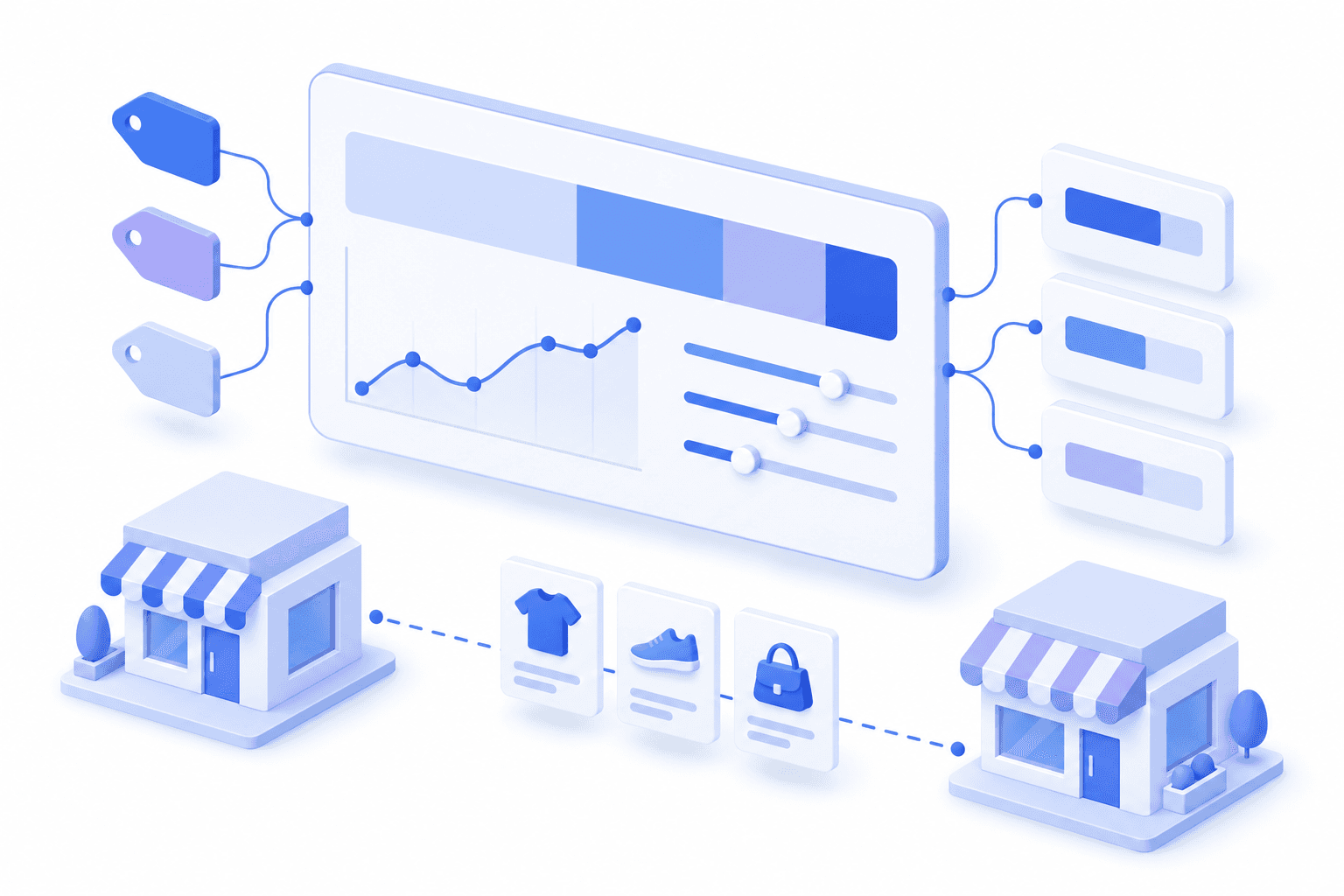
Ecommerce pricing software helps a team watch the market, calculate selling prices, and sometimes send updates to sales channels. The right choice depends on four practical points: product matching, floor-price logic, marketplace coverage, and the price changes your team still wants to review before they go live.

The essentials
- The right tool covers only the job your team needs: watch the market, calculate a price, or send it to sales channels.
- At a family garden retailer we work with, 45.4% of 23,365 products had no identified competitor and 8.2% faced intense price competition.
- A dependable floor price starts with complete unit costs. The team still owns its rules, exceptions, assortment, and legal responsibility.
- A cautious rollout checks product matches first, then enables price sync one channel at a time, beginning with one SKU.
- myPricing applies repricing rules and limits. Price sync stays off until the team enables it for a channel.
On Monday morning, your team opens the latest competitor-price export. The file shows changes across most of the catalog. Sales have not moved in the same way. Before the next marketplace update, someone must identify the products that actually need a new price.
What ecommerce pricing software should handle
Ecommerce pricing software helps your team set and update selling prices. Some tools stop after gathering market data. Others calculate a new price and send it to a sales channel.
- Price monitoring shows your team the market. The software records competitor prices but does not recommend a change.
- Pricing helps your team calculate. The software combines costs, margin targets, and market prices to recommend a selling price.
- Repricing can apply the change. Repricing means recalculating a price automatically. The software may also send that price to each sales channel.
Your team must decide where people step into the process. They may approve every new price or review exceptions only. That choice matters more than the update speed in a vendor demo.
- Price monitoring
- What it does: Collects market prices
Marketplaces: Varies by tool - Pricing analytics
- What it does: Diagnoses the current price position
Marketplaces: Rarely - Price optimization
- What it does: Models demand and elasticity
Marketplaces: Rarely - Dynamic pricing
- What it does: Adapts the price to demand and timing
Marketplaces: Varies by tool - E-commerce repricing
- What it does: Recalculates and publishes the price by channel
Marketplaces: Yes - CPQ (quotes)
- What it does: Calculates a configured B2B quote
Marketplaces: No - Full pricing suite
- What it does: Covers the whole process in one tool
Marketplaces: Varies
Choose the tool family that fits the job
| Family | What it decides | Marketplaces | Applies or advises | When to rule it out |
|---|---|---|---|---|
| Price monitoring | Nothing, it collects | Depends on tool | Neither | When prices must change |
| Pricing analytics | The diagnosis | Rarely | Advises | When nobody uses the report |
| Price optimization | The recommended price | Rarely | Advises | Without reliable sales history |
| Dynamic pricing | The price based on demand and timing | Depends on tool | Applies | Without reliable demand history |
| Ecommerce repricing | The price by channel | Yes | Either | Outside marketplaces and comparison sites |
| CPQ (quotes) | The price of a configured B2B quote | No | Advises | Outside configured B2B quotes |
| Full pricing suite | The full process | Depends on tool | Either | Without a dedicated pricing team |
Software built for physical stores may ignore the Buy Box, category-specific referral fees, or products without a shared barcode. A referral fee is the commission that a marketplace charges on a sale. Without a shared barcode, the software needs other details to recognize the same product.
A full suite needs a dedicated team. A price-optimization engine needs dependable sales history.
To compare budgets, ask for the price of your current catalog, then a doubled catalog, one more channel, and a faster monitoring schedule. Vendors use different billing units, and enterprise suites usually provide a quote, so no single category-wide range would hold. Price the same scope instead.
Which prices really need to move?
A SKU is one product record in the catalog. A family-owned garden and pet retailer grouped 23,365 products by their competitive position (the case). The team found no competitor for 45.4% of them. Another 29.1% were already better positioned, 17.3% were behind, and only 8.2% faced an active price fight.
- 45.4%No competitor
- The team found no competitor. It sets the price from the margin
- 29.1%Better positioned
- The offer is already ahead. A lower price would cut margin without a clear benefit
- 17.3%Worse positioned
- A lower price may not close the gap
- 8.2%Intense competition
- The team checks these SKUs more often
In this catalog, 8.2% of SKUs face intense price competition. The team found no competitor for 45.4% of the products. One schedule would cause unnecessary changes.
A consumer electronics seller ran a similar review across roughly 1,000 SKUs on two marketplaces. Only 30% of the catalog needed frequent monitoring. The team could check the other 70% less often (the case).
Chen, Mislove, and Wilson recorded Buy Box prices for 1,000 Amazon best sellers every 25 minutes. They identified 543 sellers that were likely using algorithmic pricing (World Wide Web Conference, 2016). With algorithmic sellers present, most products’ featured-offer prices changed.
- Facing intense price competition8.2%8.2% of 23,365 classified productsClient case, gardening and pet retail, 2026
- Monitored at high frequency30%30% of roughly 1,000 SKUsClient case, consumer electronics, 2026
- Buy Box price unchanged2%20% of products with no algorithmic seller, 2% of those with oneChen, Mislove and Wilson, World Wide Web Conference, 2016
- Fully automated8%8% of retailers that use monitoring softwareEuropean Commission, SWD(2017) 154, 2017
With an algorithmic seller present, the Buy Box price changes for most products. Set monitoring frequency according to their competitive position. Customer results are not market benchmarks.
In the demo, check how the tool groups each SKU and sets its monitoring frequency. Match monitoring frequency to Buy Box activity and competition.
The 45.4% of products with no competitor need a different rule. The garden retailer raised its prices when its margins allowed. It also sent the classification to an advertising partner each day.
Compared with similar products managed without pricing data, products with no competitor or a better position received 34% more clicks. Their conversion rate was 30% higher. Ad spend fell 13% while the French gardening market declined 6.2% that year.
Four checks before you buy
- 1Matching
By barcode (UPC or EAN), or by images and attributes, with human review of uncertain matches
- 2Full cost
Unit cost, referral fee, fulfillment, returns
- 3Rule
Market benchmark with an offset, or a target margin on cost
- 4Bounds
The team sets a floor and a ceiling. The engine stays between them
- 5Rounding
The calculated price uses the format required by the channel
- 6Review
The operator approves, locks a price, or switches the calculation off
- 7Sync
Off by default. The team turns it on channel by channel
Check the two blue steps when you compare tools. Incomplete costs distort the margin. The team keeps control: it reviews prices and activates each channel.
1. Product matching. Product matching connects one SKU in your catalog to the same item in a competitor’s offer. A shared barcode makes that connection simple.
Without one, the software compares images and attributes such as brand, size, or material. A person then reviews uncertain results.
A motorcycle-parts distributor manages more than 200,000 SKUs. Its engine approves a match above 96% confidence. A person reviews scores from 90% to 96% each week. The distributor chose the trade-specific attributes required for a match. Its team checked matches for six months before turning price sync on. Measured accuracy had reached 99%.
An organic cosmetics manufacturer followed the same method to match its private-label products with equivalent products. Ask for the accuracy rate and human-review threshold.
2. The margin floor. A floor price is the lowest price that preserves the chosen margin. One retailer selling on more than ten marketplaces set a 10% margin floor.
Its repricing rules cannot push a sale below a 10% margin, even during a Buy Box fight (the case). In a demo, check that the software actually stops there.
Check the formula on the screen as well. Markup divides profit by cost. Margin divides profit by the selling price. A 10% target produces a different floor under each formula.
3. The no-competitor rule. The 45.4% of products with no comparable offer cannot follow a market price.
A margin-based rule gives them a price. Without that rule, the software leaves them unchanged.
4. Exceptions. Your team needs a way to lock a contract price, a closeout price, or a supplier-agreed price. One locked item should not force the team to change the entire strategy.
Calculate the full cost before you set a price
The full unit cost includes every expense tied to one sale. If an expense is missing, the software protects a margin that does not exist. Amazon lists referral fees of 8% to 15% in most categories.
Amazon’s full range runs from 3% to 45%, with a $0.30 minimum per item in applicable categories. The Professional plan costs $39.99 a month (Amazon selling fees, accessed September 16, 2026).
Count costs in addition to the referral fee, whether billed by Amazon or paid elsewhere: per-unit fulfillment, storage by volume and season, purchase, packaging, returns, payment, claims, disputes, and customer-service time.
Returns are easy to miss. The National Retail Federation and Happy Returns estimated that customers returned 19.3% of online sales in 2025. NRF and Happy Returns projected returns at $849.9 billion for 2025.
The study classified 9% of returns as fraudulent (2025 Retail Returns Landscape, October 2025). A returns allowance left at zero makes the floor price unreliable.
US ecommerce sales reached $340.2 billion in the second quarter of 2026. They represented 17.1% of total retail sales.
Ecommerce grew 12.2% year over year, while total retail grew 6.7% (U.S. Census Bureau, Quarterly Retail E-Commerce Sales, August 2026). As more orders move online, more sales carry marketplace fees and return costs that the floor must cover.
A retailer selling on more than ten marketplaces discovered losses at month-end. Some products looked profitable because their costs were incomplete. The team added daily supplier prices, marketplace fees, fulfillment by channel, and return and fraud rates by category. Its 10% margin floor became dependable once those costs were in place.
Run the calculation for one SKU before comparing tools. If an input is missing, the floor price is unreliable.
- Unit costWeighted average cost if you track one
- Channel referral feeDollar amount calculated on the total paid by the buyer, including shipping and gift wrapping. Amazon: $0.30 minimum where applicable (2026 fee schedule)
- Shipping and handlingIncluding any fuel surcharge the channel applies
- Returns and claims allowanceUse your category rate. NRF and Happy Returns estimated returns at 19.3% of online sales in 2025
- Full cost of the saleMany rules omit this amount
- (1 − 10%)Margin on selling price: divide full cost by 0.90. The 10% floor comes from the multichannel retailer case
- Floor priceThe engine stays above this amount, even during a Buy Box fight
A percentage referral fee changes with the selling price. When the fee and margin use the same price basis, calculate: costs excluding referral fees ÷ (1 − margin rate − referral fee rate). Then check the fee schedule’s minimums and pricing tiers.
- Benchmark tracked: lowest price, average price, or the Buy Box price
- Offset applied to that benchmark: in dollars or as a percentage
- Ceiling price: how far you are willing to follow the market up
- Margin applied when no competitor is detected
- Rounding: the price format required by the channel
- Frequency: which SKUs need frequent updates and which can be checked less often
Our selling price and margin calculator shows the full calculation for one SKU. Use it to check your formula before comparing software.
Keep these decisions with your team
| Decision | Tool’s role | Your team’s role |
|---|---|---|
| Unit cost | Uses the input | Supplies it |
| Positioning | Applies the rule | Chooses the rule |
| Channel publishing | Waits for activation | Activates each channel |
| Assortment | Shows the situation | Decides |
| Legal liability | None | Full responsibility |
The software cannot create a dependable unit cost. Your team must supply the right inputs first. In myPricing, price sync stays off until a person enables it for a specific channel.
Few retailers hand every price change to software. The European Commission’s SWD(2017) 154 (2017) found that 53% of surveyed retailers monitored competitor prices. Among those retailers, 67% used monitoring software.
Among retailers using monitoring software, 78% adjusted their prices to competitors’ prices. Of all monitoring-software users, 43% adjusted prices manually, 27% combined manual and automatic adjustments, and 8% used fully automatic adjustments (European Commission, 2017).
A competitor may also undercut your price during every cycle. The floor prevents a loss, but the product stays at the lowest acceptable price. Your team must decide whether the product still belongs in the assortment. A software setting cannot make that call. Sellers call this a race to the bottom.
A seller may follow a competitor’s public price. Sellers may not agree with one another on the price to charge. In April 2015, the Department of Justice charged a former ecommerce executive under the Sherman Act over the prices of wall posters sold on Amazon Marketplace.
The participants had written code that told pricing software to follow their agreement (Antitrust Division, press release 15-421). A person must be able to explain every pricing rule. The same data can support supplier negotiations. An independent pharmacy showed suppliers where its costs exceeded the market price, then renegotiated its terms (the case).
Start with one SKU and expand carefully
- Calculate one SKU’s floor price by hand. If your team cannot explain the floor-price calculation for one SKU, do not automate it across ten thousand.
- Group SKUs by competitive position. That grouping determines a useful monitoring schedule.
- Check product matches before turning repricing on. Run monitoring while your team validates product matches over the following months.
- Enable price sync on one channel, then the next. Have a person review exceptions each month.
The price monitoring guide explains how to collect prices, choose a schedule, and stay within the law. myPricing dynamic repricing covers rules and price limits. The myPricing page presents the full product. The Amazon Buy Box guide explains the other factors that decide which offer wins.
Sources and methodology
- U.S. Census Bureau, Quarterly Retail E-Commerce Sales, 2nd Quarter 2026, released August 2026.
- National Retail Federation and Happy Returns, 2025 Retail Returns Landscape, October 2025.
- U.S. Department of Justice, Antitrust Division, press release 15-421, April 2015.
- European Commission, E-commerce Sector Inquiry, SWD(2017) 154, 2017.
- Chen, Mislove, and Wilson, An Empirical Analysis of Algorithmic Pricing on Amazon Marketplace, ACM, 2016.
- Amazon, selling fees on Amazon.com, accessed September 16, 2026.
- Internal metrics come from the client cases linked in this guide.
Frequently asked questions
Ecommerce pricing software helps a team watch market prices and calculate selling prices from its costs. Some products recommend a new price. Others send it to each channel. The seven tool families range from price monitoring to full pricing suites.
Repricing recalculates prices on a schedule. The software may then send each price to its channel without crossing your limits. Your team can approve every change or review exceptions only.
Ecommerce vendors often charge by tracked product URL or connected channel. Large price-optimization suites usually provide a quote. Compare the same scope: your current catalog, a doubled catalog, one more channel, and a faster monitoring schedule.
Your rule starts from a benchmark, such as the Buy Box or lowest price. It applies your chosen offset, then stops at your limits. Include Amazon’s referral fees: usually 8% to 15%, with a $0.30 minimum where applicable (Amazon fee schedule, 2026).
Yes. The software compares images and attributes, then sends uncertain matches to a person. A motorcycle-parts distributor used this method across more than 200,000 SKUs and measured 99% accuracy.
A seller may automatically follow a competitor’s public price. Sellers may not agree on prices. In 2015, the Department of Justice charged an ecommerce executive whose code coordinated prices. A person must be able to explain the rules.
Group SKUs by competitive position first. At a family garden retailer we work with, 45.4% of 23,365 products had no identified competitor. Only 8.2% faced intense price competition. One schedule for every SKU would have created many unnecessary changes.
Continue exploring




What marketplaces read off your warehouse: availability, picking accuracy, dispatch time. Jonathan Coloma, COO of Repiauto, on going from 300 to 1,000 orders a day in two years: the paper wall, ERPs built for a different problem, a go-live quoted at fifteen days, and what changed in his working day.

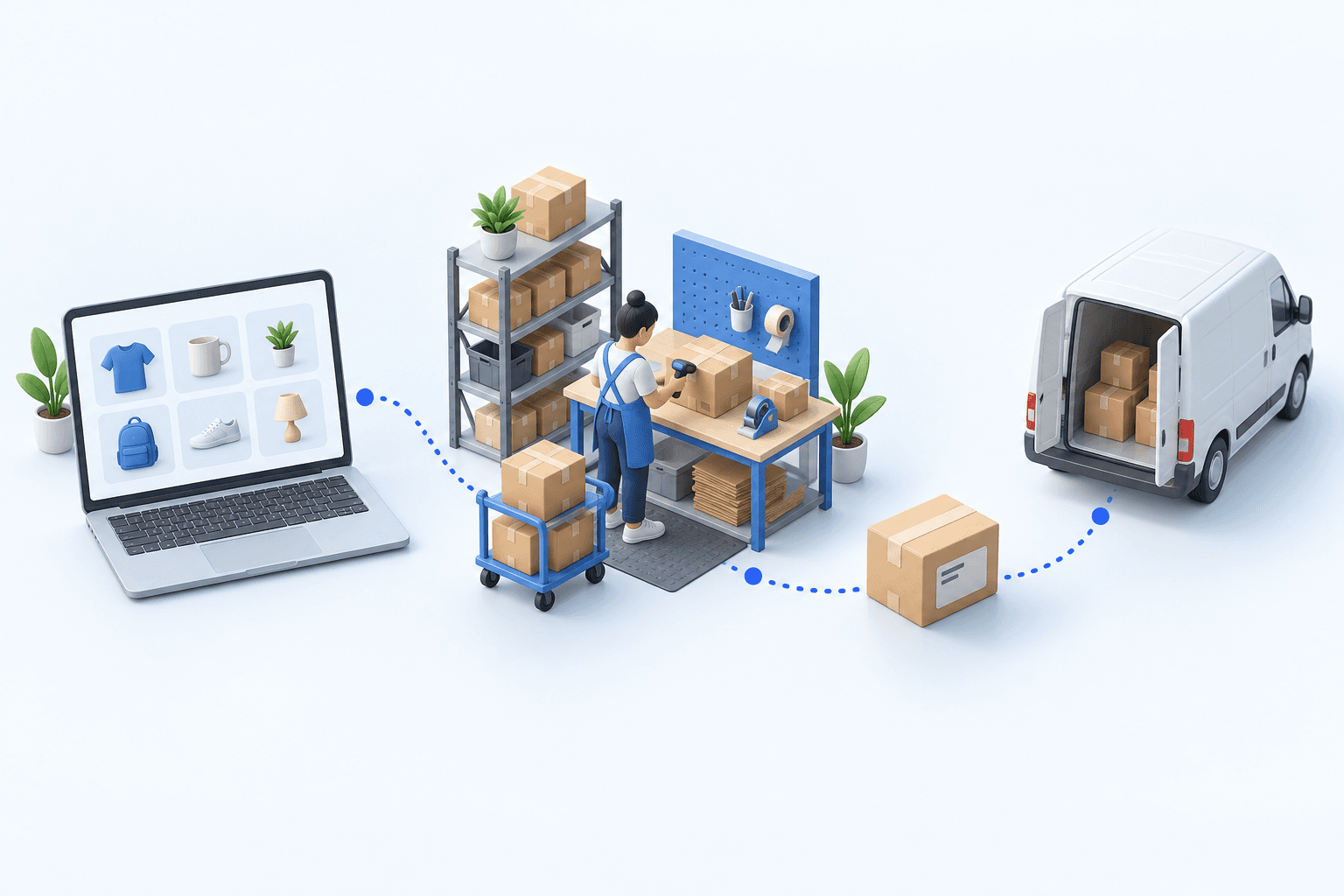
To hold up under peak volume, split the order queue into waves based on real operating constraints, then decide where barcode checks belong. At the packing bench, the operator verifies the parcel. Carrier rules select the service and print the label, so the next order can start without another decision.

Industrializing your purchasing means ordering on rules, not guesswork: at the right time (the reorder point), in the right quantity (your coverage period), from the right supplier, with a purchase order validated in one click. Available on replay.







See it in your own operations
Book a 20-minute call. We'll map your workflow and point out where it breaks. No slides.
Free 20-min call · No commitment