
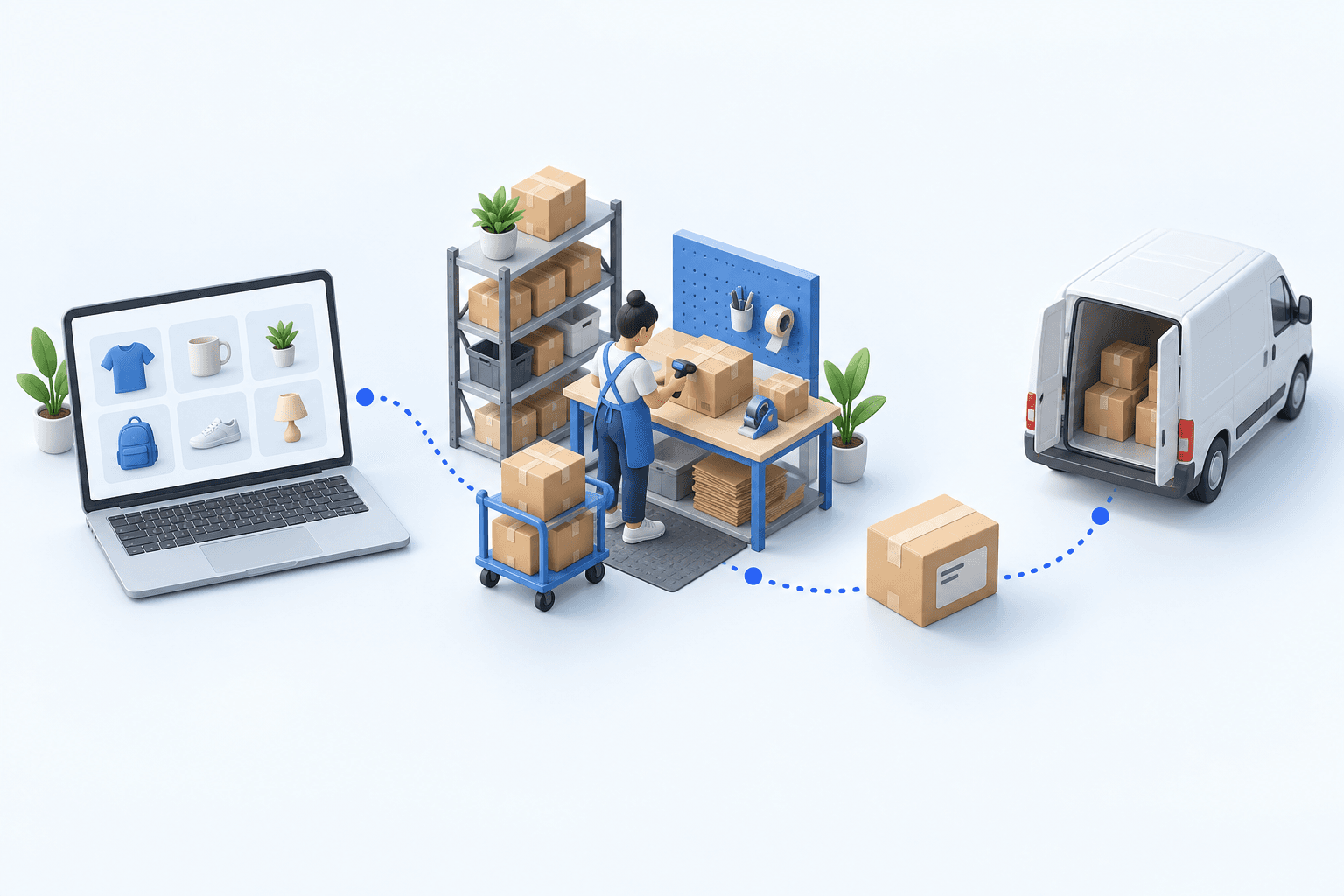
DPD Shopify: which shipping setup fits your operation?
The official DPD app often fits one Shopify store and one warehouse. A shipping platform adds a shared label workflow across carriers. An OMS/WMS makes sense when channels, warehouses, or shipping rules multiply. Whichever route you choose, test one home-delivery order, one Pickup order, and the tracking sync back to Shopify.
 By Diogo Monteiro · E-commerce Integration Expert· Updated September 22, 2026· 4 min read
The essentials
- The official DPD app may be enough for one store and one warehouse. A shipping platform brings several carriers into one label workflow.
- An OMS/WMS earns its place when orders come from several channels, stock sits in several warehouses, or the team needs carrier rules.
- A Pickup order fails when the selected pickup point ID does not survive every handoff before DPD creates the label.
- The 20-minute test uses one home-delivery order and one Pickup order, then checks both labels and tracking in Shopify.
The final DPD parcel leaves the warehouse at 5:30 p.m. The label scans correctly and the driver collects the parcel. Three days later, Shopify still shows the order as unfulfilled, with no tracking number. In a Shopify-to-DPD flow, printing the label is only one checkpoint. Tracking must return to Shopify, and a Pickup order must keep the customer’s chosen pickup point ID.
DPD Shopify: three setups. Which one fits your operation?
The official DPD app may be enough for one Shopify store shipping from one warehouse. Your team handles orders, labels, and tracking inside Shopify, with little to configure outside it.
A shipping platform groups labels from several carriers into one tool. It fits when fulfillment and inventory are straightforward and you only need a small set of shipping rules.
An OMS/WMS earns its place when orders come from several channels, stock sits in several warehouses, or the team needs rules based on weight, destination, or item.
| Setup | When it is enough | Watch for |
|---|---|---|
| Official DPD app | One store, one warehouse | Few rules outside Shopify |
| Shipping platform | Several carriers, few rules | Fulfillment and stock managed elsewhere |
| OMS/WMS | Several channels or warehouses | Broader than shipping alone |
Use the lightest setup that can pass both the tracking and Pickup tests. Shopify’s DPD documentation also describes buying DPD labels through Shopify Shipping, for merchants shipping from the UK.
The failures that matter happen after checkout
The first failure is a bad service mapping. Shopify records one delivery promise, but DPD receives another. The label may still print even when a home-delivery order has been sent to a pickup-point service, or the other way around.
The second is a missing pickup point ID. The pickup point ID selected by the shopper has to survive every handoff from Shopify to DPD. A town name is not enough. Fevad reports that out-of-home options now account for nearly half of deliveries in France (2026 e-commerce key figures). Nearly four in ten recipients prefer pickup points, according to Arcep and CREDOC (2026 study). A 2024 review in Computers & Operations Research explains why out-of-home delivery works: it consolidates parcels at one location and reduces failed delivery attempts.
The third failure is the sync back to Shopify. DPD creates a label and tracking number, but Shopify receives neither the fulfilled status nor the tracking number. In the 2026 Arcep/CREDOC study, 62% of recipients reported at least one delivery problem in six months, including missing tracking information. Arcep counted 1.7 billion parcels in 2024, up 3.7% year over year (observatory published in 2025).
With an OMS/WMS, watch four handoffs: the paid order in Shopify, picking and packing in myFulfillment, the label and tracking in DPD, then the tracking number back in Shopify.
 ShopifyPaid order
 DPDLabel and tracking
One bedding retailer runs five Shopify sites and about twenty marketplaces across France and Spain, with DPD among its carriers. It has automated 100% of its fulfillment operations. Previously, tracking was sent only after carrier collection, sometimes hours or days later. The tracking number now syncs to Shopify when packing is complete.
Run this 20-minute test before go-live
Place one paid home-delivery order and one paid Pickup order. Use order numbers your team can find quickly. In the first five minutes, check the address, items, delivery method, and the pickup point ID in the system you chose.
Spend the next five minutes on the labels. The DPD service must match the delivery method the customer paid for. Check that the address is readable and that the Pickup label carries the right pickup point ID.
Use the final ten minutes to create both shipments and then go back to Shopify. Each order should show as fulfilled with the same tracking number DPD displays.
- 1Shopify orderOrder number and delivery method presentCheck in Shopify
- 2Parcel checkItems and quantities validatedCheck at the packing station
- 3DPD shipmentLabel and tracking number createdCheck in the DPD account
- 4Tracking sync back to ShopifyOrder marked as fulfilledCheck in Shopify
The result tells you where to look. A wrong DPD service points to method mapping. A missing pickup point ID means it disappeared before label creation. A correct label with no Shopify tracking points to a failed sync back to Shopify. Fix the first failed handoff, then rerun both orders.
Choose myFulfillment when the operation outgrows one store
For one store and one warehouse, the official DPD app may be all you need. A shipping platform is a sensible middle ground when the main job is producing labels for several carriers.
myFulfillment becomes relevant when you need one queue for several stores or marketplaces, order routing across warehouses, and carrier rules that apply consistently. The OMS manages orders and syncs tracking back to Shopify. The WMS covers order prep, packing, and inventory. The procurement module covers supplier orders.
That shared rule set also prevents each new store or warehouse from becoming a separate shipping project.
If your team repeats the same rule in several stores, reconciles shipments by hand, or cannot see where the stock is held, an OMS/WMS is a better operating layer than one app per store.
For setup details, use the DPD integration and Shopify integration pages.
Frequently asked questions
Use the official app for one store, one warehouse, and few rules. Choose an OMS when you need a shared order queue and consistent Shopify tracking to manage several channels, warehouses, or shipping rules.
Yes, if the order keeps the shopper’s selected pickup point ID through to DPD. Check that ID in Shopify, your shipping system, and the label before go-live.
It should when your setup writes the fulfilled status and tracking number back after shipment creation. A printed DPD label alone does not guarantee that Shopify received the update.
Yes. One OMS can centralize every store’s orders and apply the same rules across them.
Continue exploring
What marketplaces read off your warehouse: availability, picking accuracy, dispatch time. Jonathan Coloma, COO of Repiauto, on going from 300 to 1,000 orders a day in two years: the paper wall, ERPs built for a different problem, a go-live quoted at fifteen days, and what changed in his working day.

To hold up under peak volume, split the order queue into waves based on real operating constraints, then decide where barcode checks belong. At the packing bench, the operator verifies the parcel. Carrier rules select the service and print the label, so the next order can start without another decision.

Industrializing your purchasing means ordering on rules, not guesswork: at the right time (the reorder point), in the right quantity (your coverage period), from the right supplier, with a purchase order validated in one click. Available on replay.
See it on your own operations
Book a 20-minute call. We'll map your workflow and point out where it breaks. No slides.
Free 20-min call · No commitment