

Ecommerce order management: choose the right OMS
Ecommerce order management coordinates order records, reservations, allocation, and system handoffs across sales channels. An OMS controls the decision layer while ERP, WMS, and TMS execute their own jobs. This guide compares five OMS approaches and shows how to test each one with real orders and deliberate failures.

The essentials
- Ecommerce order management centralizes orders from connected sales channels in one operational record.
- The OMS owns allocation and handoffs; ERP, WMS, and TMS retain their respective roles.
- Dedicated OMS, ERP, WMS-led, platform-app, and 3PL approaches fit different operating models.
- A useful demo proves recovery from shortages, duplicates, cancellations, and failed handoffs.
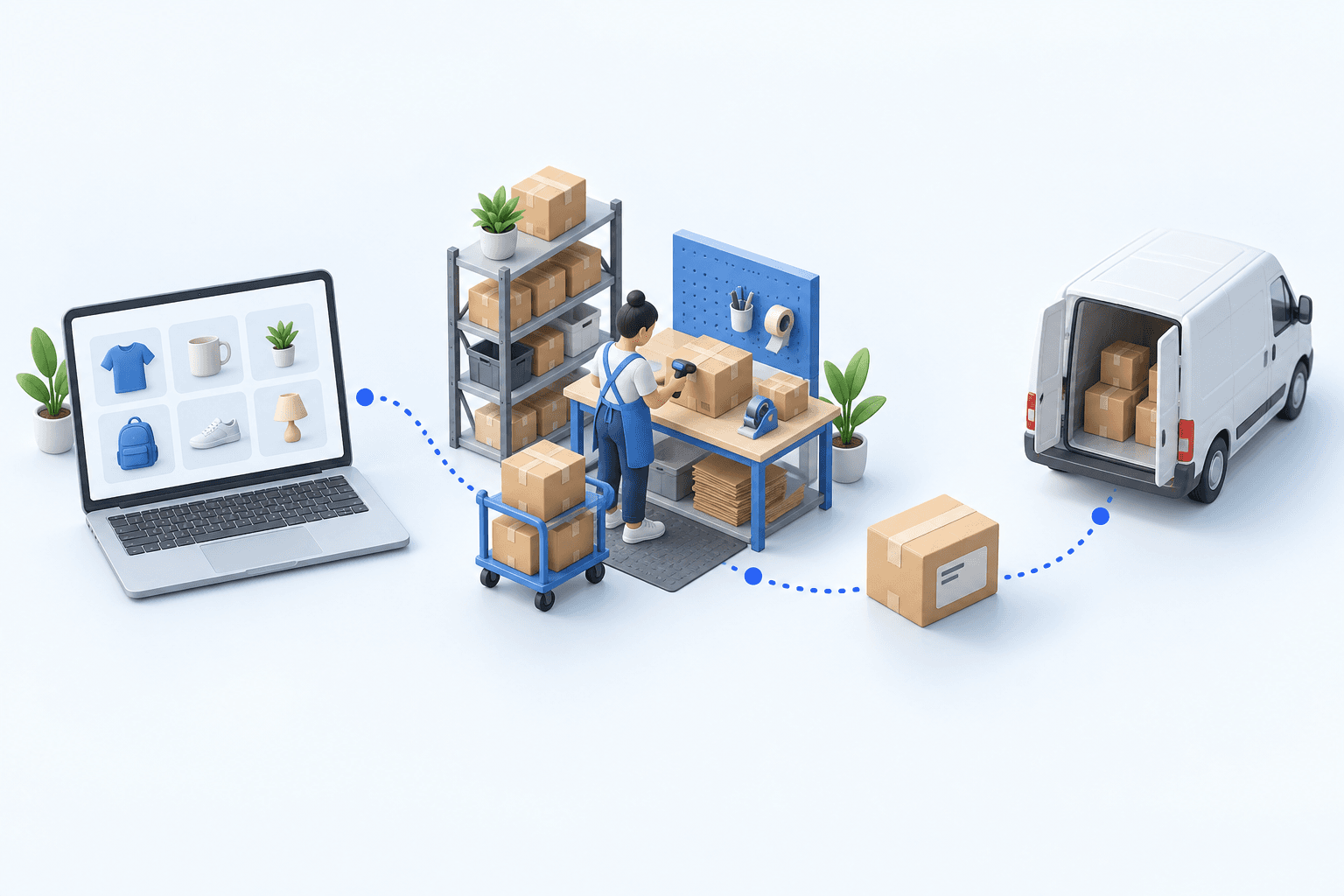
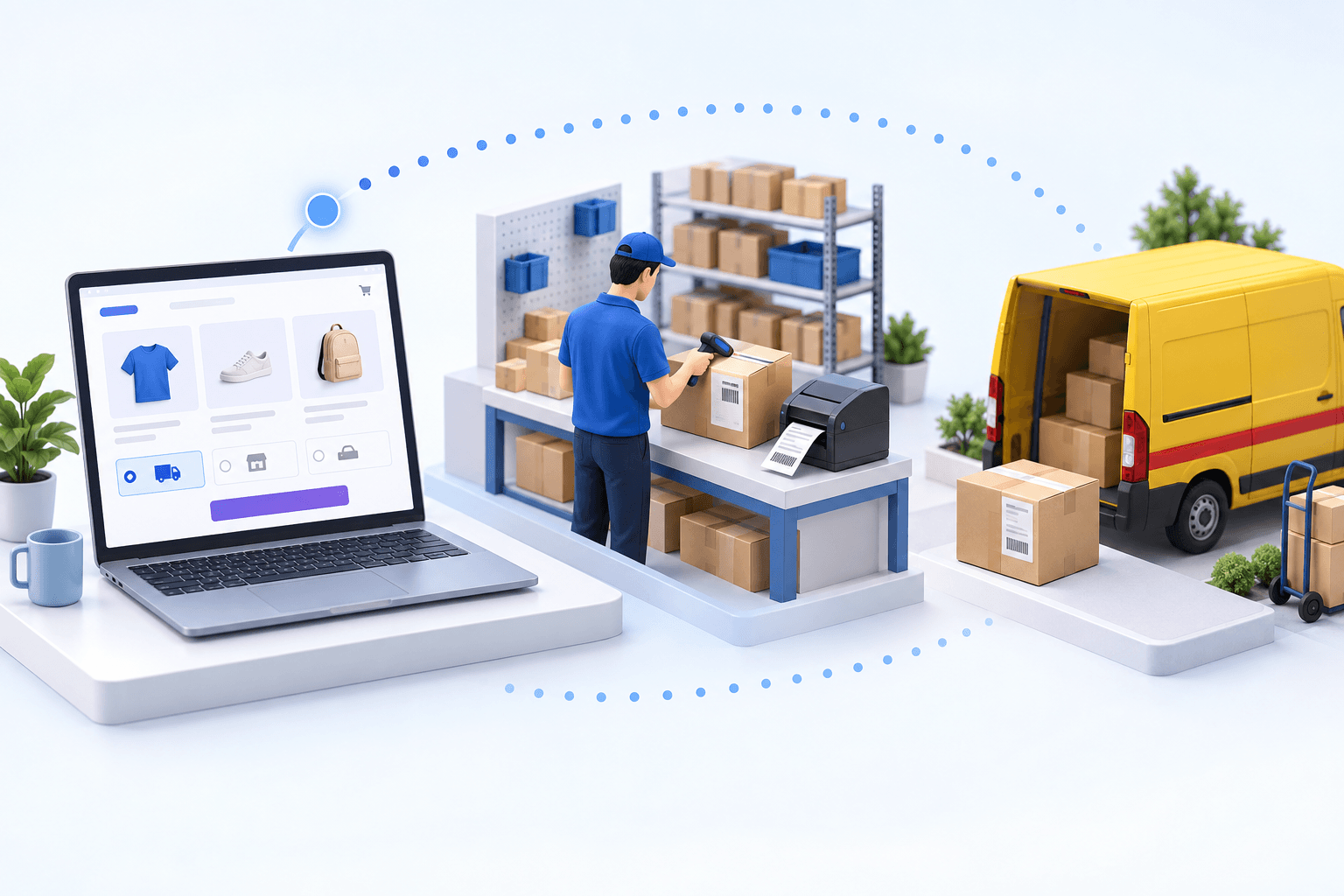
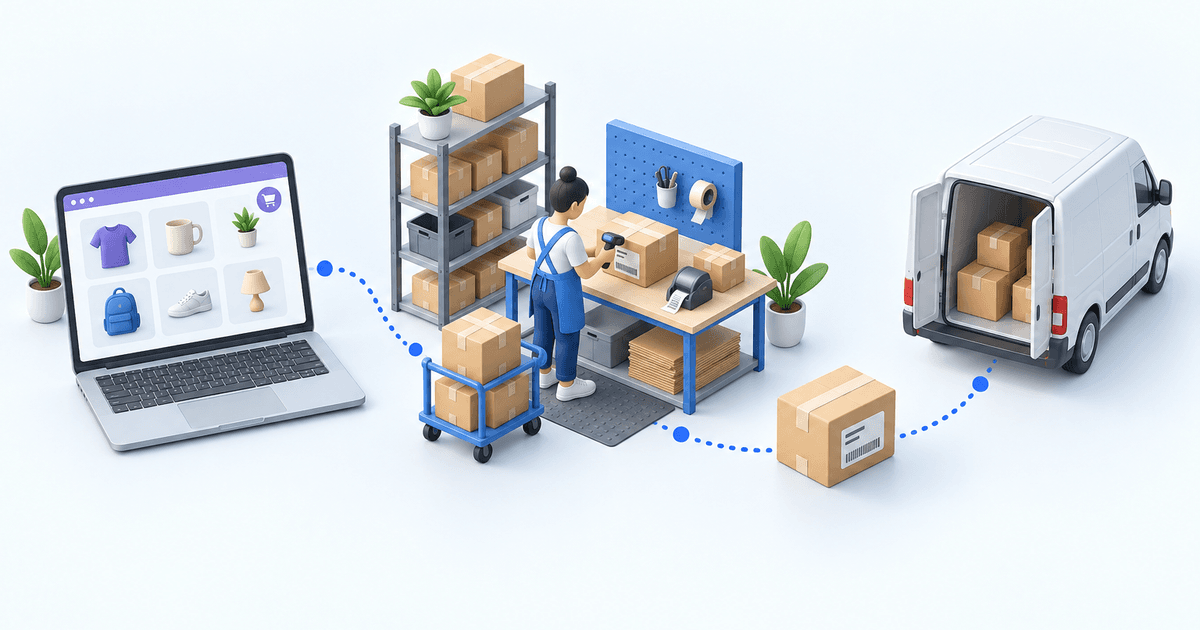
Ecommerce order management coordinates every customer order from channel import to allocation, fulfillment, and delivery updates. An order management system (OMS) keeps the operational record, reserves available stock, applies routing rules, and passes work to the right warehouse and carrier systems. It becomes valuable when people otherwise reconcile the same order across channels, inventory pools, or locations.
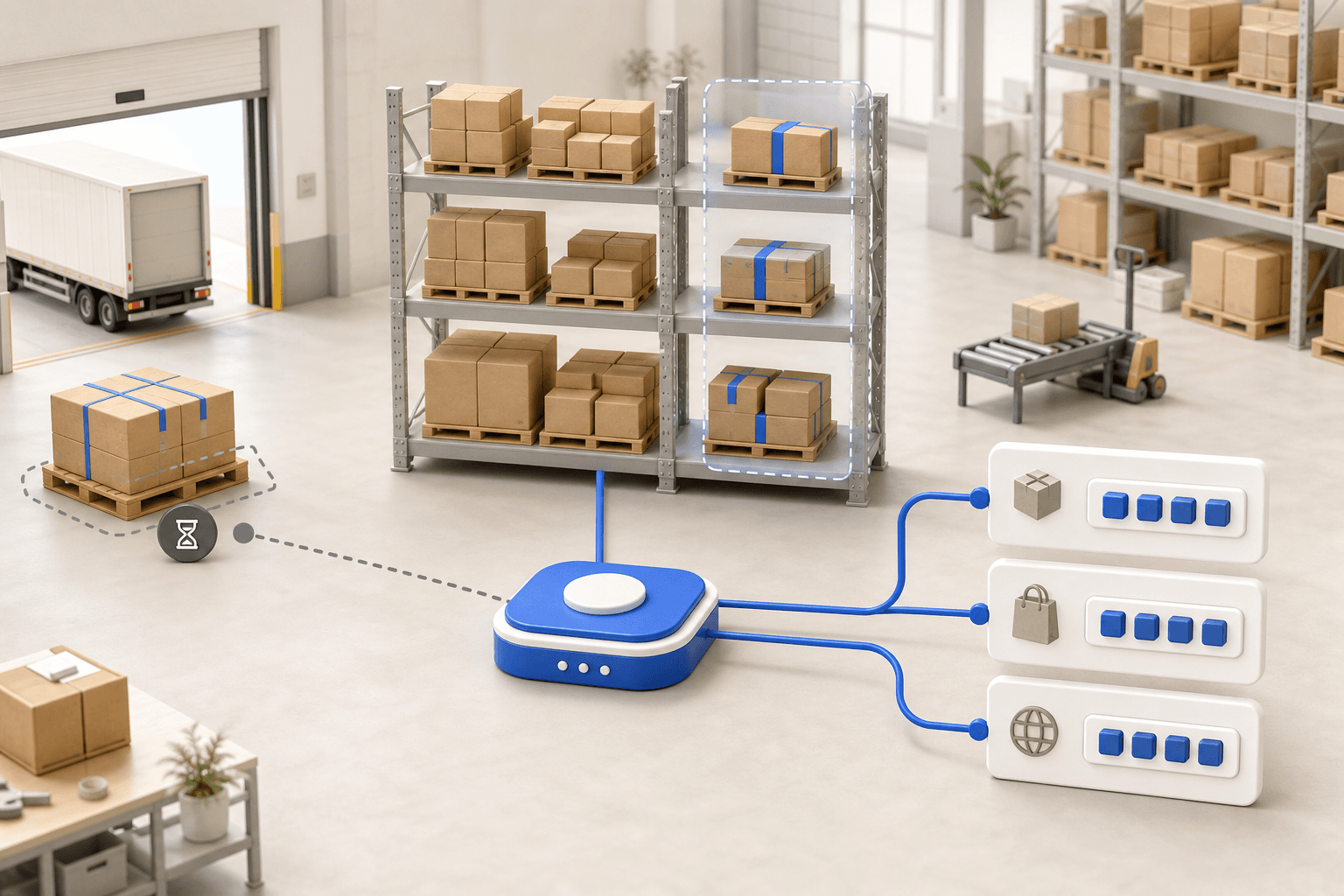
One unit is left. Two customers buy it through different channels while both screens still say "in stock." The OMS decides which order receives the reservation. The warehouse management system (WMS) guides the picker; the transportation management system (TMS) handles the shipment and tracking events.
Order and triggering status
Import, reservation, and allocation
Quantity sent back to the channel
Picking and packing
Shipping and tracking updates
Record the order ID, SKU, time, and result at every handoff. When two screens disagree, that trail shows where the records first diverged.
Before comparing products, name the official source for the order, master SKU, inventory you can still promise, and status. A label print may mean "shipped" in one system, while another waits for carrier collection. Resolving that mismatch is an operational decision.
When does ecommerce order management need its own system?
US retail ecommerce sales reached $340.2 billion in the second quarter of 2026, or 17.1% of retail sales (U.S. Census Bureau, 2nd Quarter 2026). The operational buying threshold comes from recurring reconciliation within one merchant's order flow.
Look for recurring reconciliation. An OMS earns its place when staff re-key orders, arbitrate the last unit, assign lines to several locations, or recover failed channel and warehouse handoffs every day.
Two channels show the last unit, so a person chooses which order to fill. Two locations hold the item, so a person chooses where it ships from. When this happens all day, the team keeps making the same choices by hand.
One European home-and-garden retailer kept five browser tabs open for five sales channels and updated a spreadsheet "when they had time." After centralization, the team recovered four hours a day.
What should the OMS own, and what stays with ERP, WMS, and TMS?
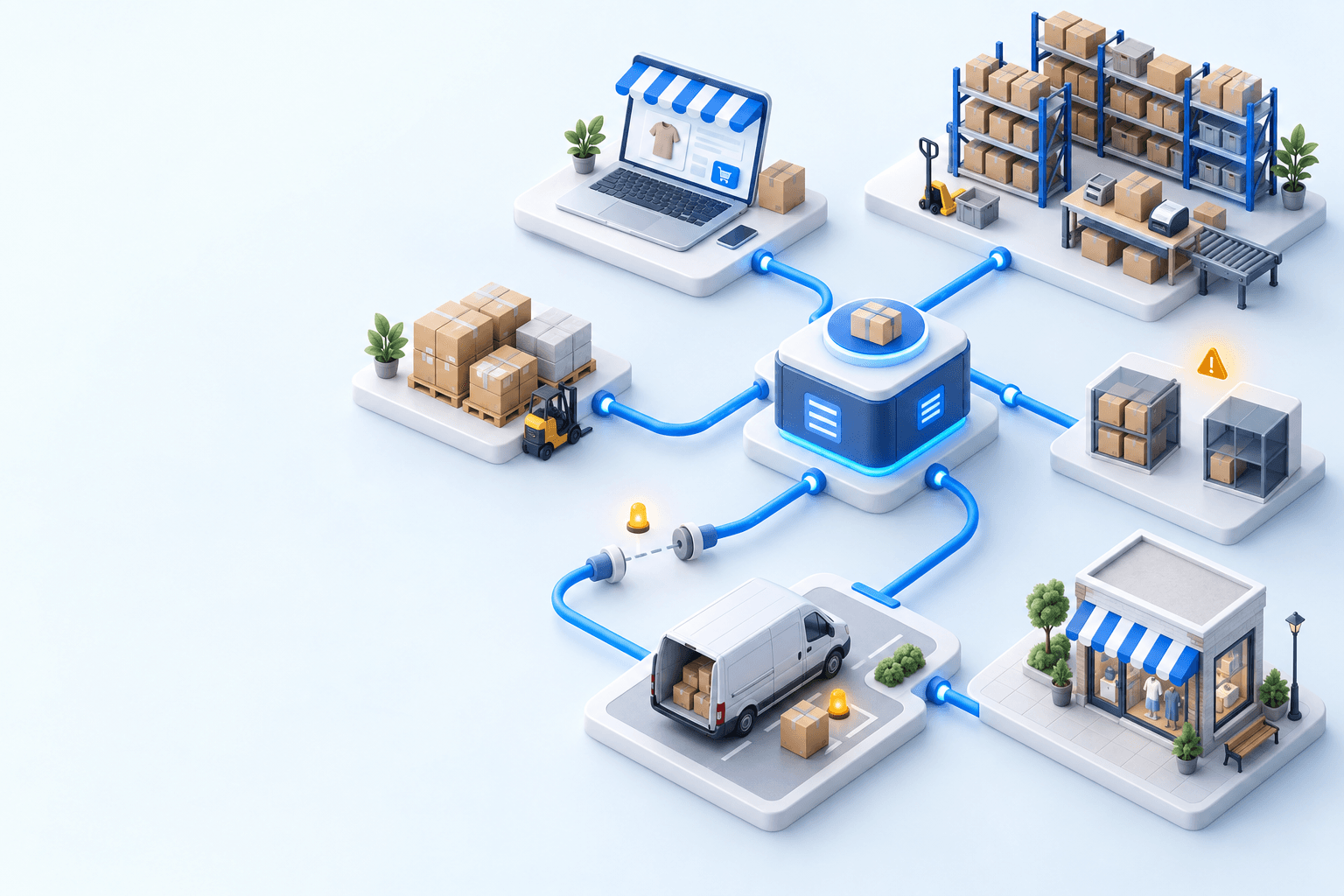
The OMS owns the operational customer-order record, reservations, allocation rules, and status orchestration. The enterprise resource planning system (ERP) usually remains authoritative for purchasing, finance, and company master data. The WMS directs physical warehouse work. The TMS selects the shipping service and collects delivery events.
| System | Decision it holds | Work it performs | Data it owns |
|---|---|---|---|
| OMS | Fulfillment location and route | No physical work | Orders, reservations, rules |
| ERP | Company planning | Accounting entries | Master data, purchasing, finance |
| WMS | Warehouse path | Picking, checking, packing | Locations, physical inventory |
| TMS | Shipping method | Labels and tracking | Packages, carrier, delivery |
Product boundaries vary. Some ERP suites include warehouse functions; some OMS products calculate sellable inventory. The ecommerce ERP guide and ecommerce WMS guide provide system-specific selection criteria.
An order line may also need a different fulfillment location from the rest of its order. The OMS keeps the complete order visible and sends each warehouse only its assigned tasks.
3 lines, 1 customer, 1 promise
Available stock, location, lead time
2 lines allocated
1 line allocated
Ships when every line is ready
The team uses OMS rules to assign the lines and keep the order open. Each WMS receives only its location’s tasks. If nobody monitors the complete order, a line without a location may never move.
A European multi-brand group kept multi-warehouse splitting in its OMS because its 3PL subsidiary's WMS could not split the customer order. At a retailer operating in France and Spain, rules assign lines by country, warehouse zone, and product type. Across both client cases, the OMS holds the multi-location allocation rules.
For every shared field, choose one system of record. Then document the trigger, acknowledgement, timeout, duplicate rule, and person who restarts a failed handoff.
The MCP server for your OMS gives your AI assistant access to order data.
Which OMS approach fits your operation?
The wider ecommerce market explains why channel overlap matters. Eurostat reports that 85.65% of EU enterprises with web sales used their own website or app and 45% used an ecommerce marketplace in 2024. The minimum possible overlap is therefore 30.65%: 85.65 + 45 - 100. The figure below combines that dated market calculation with three separate Boostmyshop client cases.
Eurostat publishes the first two shares. We calculate the minimum overlap: 85.65 + 45 − 100 = 30.65. At least 30.65% of enterprises therefore belong to both groups.
- 5channelsHome and garden, five channelsThe team recovered 4 hours a day, moved to same-day shipping, and cut new-hire training from 3 months to 2 weeks.
- 2023acquisitionMulti-brand groupThe external WMS runs warehouse tasks. The team keeps multi-warehouse splitting and the custom B2B portal in the OMS.
- 25+channelsBedroom products, France and SpainThe team uses rules for each country, warehouse zone, and product type. The system sends tracking when packing finishes.
These three Boostmyshop client cases show their reported project results.
Use the decision table to choose an architecture before you shortlist products. "Best fit" identifies the operating model that usually makes each approach worth testing.
| Approach | Best fit | System of record | Proof to demand | Trade-off or integration |
|---|---|---|---|---|
| Dedicated OMS | Many channels and locations | OMS order and reservations | Split, recover, replay one order | Integrate ERP, WMS, TMS |
| ERP commerce module | Finance and master data dominate | ERP master and customer order | Preserve accounting after failure | Add WMS depth when needed |
| WMS-led suite | One warehouse drives complexity | WMS inventory and execution | Reserve, pick, reconcile shortage | Add orchestration across locations |
| Commerce-platform app | One storefront, limited complexity | Storefront order and inventory | Handle duplicate and cancellation | Revisit as channels multiply |
| 3PL network | Fulfillment is outsourced | Provider order and inventory | Export history, recover exception | Accept the provider's model |
The table narrows the architecture. Test the shortlisted approach against your channels, locations, order states, returns, and recovery process.
What should an ecommerce OMS prove in a demo?
Give every provider the same pack: one real order, one SKU, two locations, and one deliberately broken handoff. Ask each provider to show the evidence on screen.
| Capability | Scenario to run | Evidence to demand |
|---|---|---|
| Order import | Accepted, ignored, invalid orders | ID, log, rejection reason |
| Reservation | Two channels sell last unit | Formula and reservation time |
| Allocation | No location fills whole order | Rules, reason, unallocated line |
| Picking | Order wave has shortage | SKU, quantity, location, bin |
| Recovery | Stop and restore handoff | Error, owner, replay action |
| Tracking | Shipment enters exception | Status history and timestamps |
| Returns | Resalable and rejected items | Decision and republish time |
| Audit | Change rule and status | Roles, log, event export |
In a 2008 study of close to 370,000 inventory records across 37 stores owned by one retailer, DeHoratius and Raman found that 65% were inaccurate (Management Science). Include record-accuracy controls in the demo alongside the OMS tests.
In a demo, enter a deliberate mismatch between the physical count and the published quantity. Ask which system wins, which alert appears, and how staff correct and republish the record without creating another order error.
How should you shortlist and score OMS options?
Write the scorecard before the first demo. Start with deal-breakers: required channels, locations, system-of-record rules, recovery controls, audit history, and data export. A failed deal-breaker ends the evaluation even when the average score looks strong.
The complete file
OMS scoping matrix (XLSX)
Reading the page is free. Enter your work email to get the file.
The complete file
OMS scoping matrix (PDF)
Reading the page is free. Enter your work email to get the file.
| Topic | Question to answer | Expected output |
|---|---|---|
| Channels | Where do orders start? | Inbound-flow list |
| Inventory | Who publishes availability? | Inventory map |
| Statuses | Which system is authoritative? | Status dictionary |
| Scenarios | Do rules survive exceptions? | Business test set |
| Interfaces | Who sends what to whom? | Interface contract |
| Alerts | Who sees a failure? | Recovery register |
| Scoring | Which evidence is comparable? | Weighted score |
| Go-live | Can the team roll back? | Decision sheet |
Set each weight in advance. Score from 0 to 5 only after the matching evidence appears; leave the cell blank when it does not. Record assumptions beside the score so a later reviewer can reproduce the decision.
How do you launch without losing orders?
Choose a small set of recognizable orders and run the old and new processes together. Compare the OMS, ERP, WMS, and TMS record after each handoff. Write the rollback procedure before switching traffic.
| Control | Release condition |
|---|---|
| Order import | Every test order has one record |
| Inventory | Reservations reconcile by SKU and location |
| Handoffs | Failures have an owner and replay path |
| Rollback | Staff can resume the previous process |
- Assign responsibility. Name the system of record and owner for orders, SKUs, quantities, and statuses.
- Describe each handoff. Record its trigger, required fields, acknowledgement, timeout, and recovery method.
- Run failure tests. Include a shortage, split, cancellation, duplicate, return, and connector outage.
- Clean master data. Remove duplicate SKUs, align statuses, and check locations before import.
- Reconcile the parallel run. Compare the same orders across all connected systems.
- Rehearse rollback. Name who stops the flow, the manual fallback, and the data to reconcile.
- Let users decide. Go live after operators have tested alerts and recovery themselves.
The order management module provides the OMS layer within Boostmyshop. Its warehouse management and transport management modules cover the corresponding execution included in a project. To test the fit, request a demo using one of your orders.
Sources
- U.S. Census Bureau, Quarterly Retail E-Commerce Sales, 2nd Quarter 2026, released August 18, 2026: $340.2 billion and 17.1% of US retail sales.
- Eurostat, E-commerce statistics, 2024 data extracted February 2026: 85.65% own website or app; 45% marketplace.
- DeHoratius and Raman, Inventory Record Inaccuracy, Management Science, 2008: close to 370,000 records in 37 stores owned by one retailer.
- Boostmyshop client cases from three European retailers: multi-brand group, home-and-garden retailer, and France-Spain retailer.
Frequently asked questions
An ecommerce OMS keeps channel orders in one operational record. It reserves available inventory, applies allocation rules, and sends work to warehouse and transportation systems. Its modules, connectors, and configuration determine the exact scope.
OMS stands for order management system. In retail, it coordinates the customer order, inventory reservation, fulfillment allocation, and status updates across sales channels and locations.
The OMS follows customer orders through operational handoffs. The ERP handles broader functions such as planning, purchasing, finance, and accounting. When they exchange a field, only one system should remain authoritative.
The OMS assigns an order to a fulfillment location. The WMS then guides picking, checking, packing, and inventory movements inside that warehouse. After execution, it reports the result to the OMS.
No. A CRM manages customer relationships, sales activity, and service context. An OMS manages the operational order, reservation, allocation, fulfillment handoffs, and order statuses. The two may exchange customer and order data.
The fit depends on channel count, fulfillment locations, system-of-record requirements, and who executes orders. Compare a dedicated OMS, ERP module, WMS-led suite, commerce-platform app, and 3PL network against the same failure tests.
One storefront with limited fulfillment complexity can remain on its ecommerce platform. Test a separate OMS when teams reconcile several channels, inventory pools, locations, or failed handoffs every day.
Continue exploring



Stock availability, picking accuracy, and shipping times affect marketplace sales. Jonathan Coloma, COO of Repiauto, explains how his team went from 300 to 1,000 orders a day in two years. He describes the limits of paper-based work, ERPs built for different needs, a go-live estimate of fifteen days, and changes to his daily routine.

To hold up under peak volume, split the order queue into waves based on real operating constraints, then decide where barcode checks belong. At the packing bench, the operator verifies the parcel. Carrier rules select the service and print the label, so the next order can start without another decision.

Industrializing your purchasing means ordering on rules, not guesswork: at the right time (the reorder point), in the right quantity (your coverage period), from the right supplier, with a purchase order validated in one click. Available on replay.














On December 16, set up a project with instructions and reference documents, then produce a Monday operations brief from an export with no customer data. You will leave with the workspace and a record of the requests that work for you. The live session is in French; the replay and training materials will be available in English.
A well-interpreted search reveals what customers want, even without a sale. This Boostmyshop × Venture.ia replay shows how Findy turns that signal into conversions, then how Boostmyshop reserves stock and opens its data to Héhocom so picking and delivery can keep up with order growth.
On January 20, find out in five minutes who already uses which AI tools, prepare a one-hour awareness session and get two volunteers started. You will leave with the outline for that session, a plan for the volunteers and three rules covering company tools, a fixed-price subscription and customer data.
On March 31, compare your project with its baseline for time and errors, and work out what it costs. Decide what to scale, what to stop and when to reduce review. You will leave with a before-and-after comparison, a 90-day plan, the method on one page and the outline of your next project.
On February 17, score 10 tasks for operational pain, difficulty and whether the result can be checked. For each one, decide whether it needs a setting, your AI assistant or a process change, or whether it can wait. You will choose one verifiable task and record its baseline with 5 timed cases and the previous month’s errors.
On March 3, decide what your AI assistant reads, what it prepares, what it must not change and who approves. You will leave with the connection map for your project: the sources, a dedicated read-only account to start and the person responsible for approval.
A successful migration does not replace everything at once. It starts by deciding what to keep, replace or connect, then sequences each move around the work people actually do. On December 10, Boostmyshop and Dedi Agency will map those choices from the storefront to day-to-day operations.
AI still feels like a black box when teams do not know what it actually does. On November 25, David Butin will draw on lessons from three years of using AI at Boostmyshop. He will answer a broad question: where do you start if you want to explore AI, get your organization moving and bring your team along? He will explain, without jargon, what an AI assistant can and cannot do and why critical thinking still matters. The practical perspective will come from e-commerce business leaders at the roundtable, including Arnaud Darsonval of La Ferme de Sainte-Marthe. The live session will be in French. The replay and training materials will be available in English, so English speakers can register.
On March 17, complete the inventory of AI use across your team, give each AI assistant its own account and choose between a subscription and usage-based billing. You will leave with a one-page AI policy and a test to check whether an internal tool is still open on the web.
On February 3, start from a risk-free exercise: the Monday operations brief from step two or your volunteers’ task. Write it down exactly as the team performs it, add three concrete checks and test the result on known cases. You will leave with a tested procedure: its instructions, its checks, a column for discrepancies and around ten cases whose answers you already know.
Let’s review your order workflow
In 20 minutes, we’ll identify bottlenecks and ways to save time. No slides.
Free 20-min call · No commitment